 Youthscape Home


 Back to news
At the beginning of this month (October 2026), Theos published their report 'Beyond "Christian Nationalism"'. Having attended their launch event and spent some time digging into the report, our Head of Research, Hannah, gives you an overview of the findings.
Following on from a series of far-right marches, events, rallies, and so on which included Christian images, symbols, messages, and wider content, the terms 'Christian' and 'Nationalism' became 'fused together in the public mind' (p12). There has since been little clarity or agreement on what this term encompasses, means, and/or represents. As a relatively understudied topic within the UK context, Theos set out to explore public attitudes toward 'Christianity' and 'Nationhood' as a way to understand the overlap between the two. A survey was conducted across 10,848 adults in 6 countries (UK, Romania, Germany, France, Poland, and Hungary).
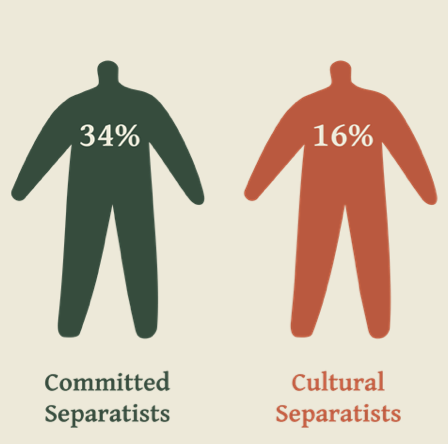
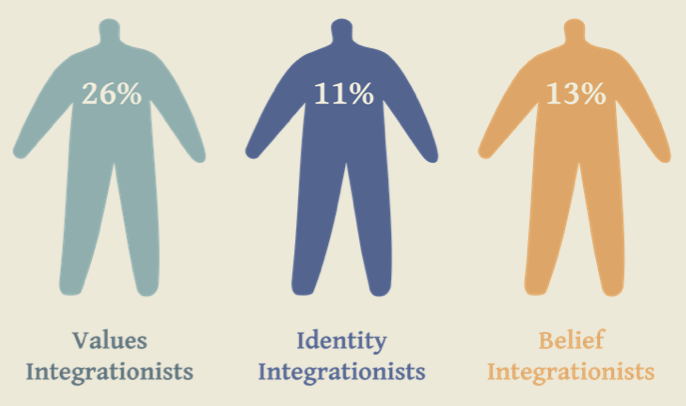
This report draws upon the responses of the 1,765 adults within the UK, to which a form of analysis was applied that enabled the research team to 'identify groups within the general public' (p19) so as to explore the 'perceived (and desired) relationship between Christianity and Britishness' (p3). In short, this analysis led to the identification of 5 groups: committed separatists, cultural separatists, values integrationists, identity integrationists, and belief integrationists:

The 5 groups fit into two categories: separatists and integrationists.
- Separatists - Christianity and national identity should be kept separate (the two groups differ in motivation and extent of ideal separation)
- Integrationists - Christianity and British national identity should be integrated (the three groups differ in the ways, degrees, and reasons for integration)
So, what are these 5 groups and what are there similarities / differences?
1. Committed Separatists, in short, do not see Christianity as part of Britishness and do not have a strong national identity. Representing 34% (the largest group), this group reject both Christian Nationalism and 'Christian involvement in Britain's political, legal, or social infrastructure' (p30). This group is more likely to say they do not have a religion (but not all!) and, demographically, more likely to be female, younger, better educated, and more likely to feel an affiliation for Green (other demographic characteristics can be found in the report).
2. Cultural Separatists, in short, also do not see Christianity as part of Britishness but are hostile to other cultures / religions occupying that space. Similar to Committed Separatists, this group are aligned with the separation of Christianity and national identity but 'don't care about it with committed passion' (p34) and lean toward a 'cultural understanding of Britishness' (p39).
These two groups largely have the same views but their differences can be seen when looking at the reasons.
3. Values Integrationists, in short, do not feel one has to be Christian to be British but Christianity is an important element of British values which therefore needs protecting. This group favours 'some kind of 'soft' institutional 'entanglement' between Christianity and the British state, law, and culture' (p45). They are interested in preserving certain aspects of Christianity, but not in an 'exclusionary' manner (p49). Christianity, for this group, is a 'value-based phenomenon', that is historical and therefore worth defending.
4. Identity Integrationists, in short, believe that Christianity is fundamental to Britishness and want to defend the country's Christian heritage from external 'threats'. This is the group that would most neatly fit under the title 'Christian Nationalists'. Motivated by external 'threats', this group (which is the smallest, representing 11%), 'are as adamant and clear as Committed Separatists about the proper relationship between Christianity and the British state', just in the opposite direction (p57). Culturally Christian as opposed to practicing, there is a 'substantial racist contingent' amongst this group (p66).
5. Belief Integrationists, in short, like Identity Integrationists believe that Christianity is integrated with Britishness but is more about promoting their faith over the preservation of values. Within this group there is a streak of Christian Nationalism with a motivation of internal doctrine rather than external 'threats', that is faith over culture. Wanting to 'promote' rather than 'preserve' Christianity, interestingly 34% of this group agree that "social problems today are ultimately down to the erosion of traditional masculine values" (p78).
In the second part of the report, following exploring each of the groups, a mapping exercise is undertaken as a way to see what happens when the groups are mapped on to one another. From this, several conclusions emerge including (p10):
— 'Attitudes to Christianity and Britishness are not just a function of people’s Christian beliefs. It is not simply the case that you can predict someone’s views on these matters on the basis of their Christianity (or lack thereof)'
— 'Attitudes to Christianity and Britishness are part – in some ways a subset – of wider attitudes to the significance and ‘thickness' of national identity generally. To understand “Christian nationalism”, it is important to understand nationalism first'
Thus:
— 'Committed Separatists look like Internationalists, with a limited attachment to the nation'
— 'Cultural Separatists look like nationalists but with a slightly ambivalent attitude to the nation they want to protect
— 'Values Integrationists look like generic patriots, largely untouched by the passions of this debate'
— 'Identity Integrationists look like nationalists whose nationalism is fortified by an attachment to Christianity'
— 'Belief Integrationists look like Christians whose Christianity moves them towards a form of nationalism'
What Does This All Mean for Youth Ministry?
In sense, the report identifies something reassuring - Christian Nationalism, as a harmful view based on prejudice, racism, and so on, currently stands as a a minority view within the UK. For many of the Christians (culturally and practicing) who fell within the Values Integrationists and Belief Integrationists groups, Christianity is something to be protected and, for those who practice Christianity, want it to 'shape public life through its teachings, including welcoming asylum seekers and caring for the vulnerable' (Kandiah, 2026). However, this latter group also has a 'streak' of Christian Nationalism and hold some troubling views which lean toward 'undemocratic means to achieve their religious and national ends' (p85):
- 37% of this group say being White is important to being 'truly' British
- 54% of this group say they are proud of Britain being 'predominantly White'
- 60% of this group say Britain is too ethnically mixed
- 62% of this group say we need "strong man" political leaders
Upon reading the report, there are a few things that feel important to the context of youth ministry:
1. This report tells us something more about the homes in which young people are living, particularly when we look at the demographic characteristics of each group. Although these are general demographic characteristics (please don't use them as 'hard facts'!), they can give us insight into the views that the young people in our groups are more likely to be surrounded by.
2. Until now, we have been concerned over the media coverage of Christian Nationalism (in its harmful, 'Othering' form) and how this might be impacting young people and their routes into / through Christianity / the Church (see Helen Paynter's work, including our chapter in her most recent book 'Faithful Presence in a Fracture World: A Toolkit for Resisting the Far-Right') without research to confirm / deny these fears. Whilst this research is focussed on adults, this report helps us to begin to 'peel back the layers' and better understand the term 'Christian Nationalism' and what does / doesn't fit into this 'catch-all' term.
3. The report helps us to look at the nuance that underpins people's views when it comes to the link (or not) between Christianity and British, national identity. Whilst different individuals might present the same views, the driving motivations for these might differ inordinately. What the reminds us of, then, is that when young people share concerning views in this area, it is imperative that we try to scratch beneath the surface to understand the 'why'. Sometimes young people might be able to articulate the 'why', other times they might need our support to think about it critically. Whatever the view, it calls us to both to 'challenge racism, hostility and the misuse of Christian symbols, while also offering compassion to those who perpetuate them' (Kandiah, 2026).
What we still don't know, however, is the degree to which these views are impacting young people and that's exactly what The Youthscape Centre for Research will be looking at over the next 2 years. Whilst we're not quite ready to 'launch' our project, we are committed to further understanding far-right views and its intersection with young people and their discipleship journeys. Keep your eyes peeled in the coming months for more information about the project and how you / the young people in your group might be able to participate!
